
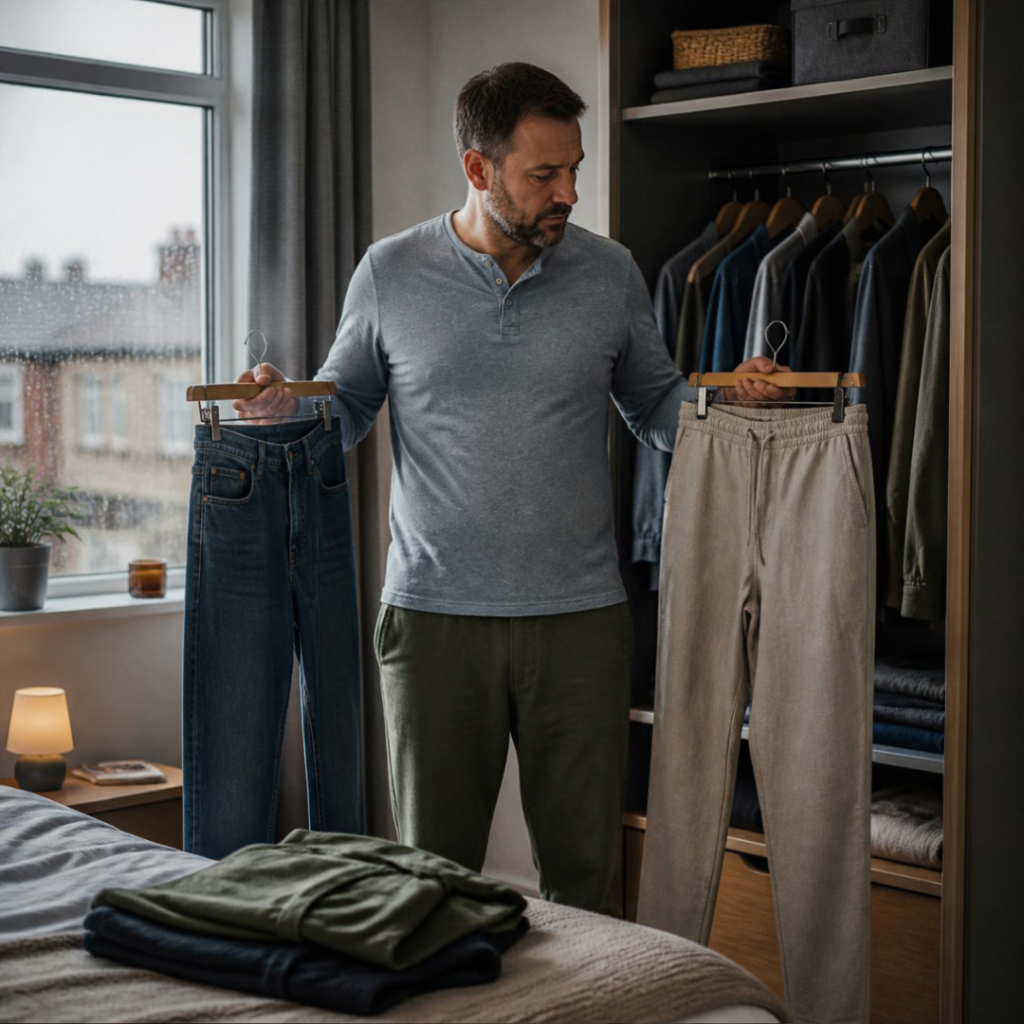
It’s not vanity. It’s friction.
If you’ve got HS, you already know the quiet arithmetic of getting dressed: will this waistband dig in? Will this seam sit right on a flare? Will I make it to the school run without rearranging myself in a car park like a bloody contortionist?
People who don’t live with this hear “clothes” and think fashion. We hear rub, heat, seams, hold the dressing, don’t make today worse.
I’m not your GP and I’m not selling you a brand. This is lived experience from years of HS — Stage 3 territory in my own story — plus a few plain lines from UK sources. No medical advice. Just wardrobe reality for UK life: work-from-kitchen-table days, buses, kids, rain, and the odd day you still want to look like a human being.
What the UK sources actually say (short)
You don’t need a seminar. The official self-care lines are blunt.
NHS lifestyle advice for hidradenitis suppurativa includes: wear loose-fitting clothes.
The British Association of Dermatologists’ patient leaflet self-care list includes: avoid tight clothing and tight underwear.
Leeds Teaching Hospitals’ HS patient information says: avoid wearing tight clothing or underwear that can cause friction.
That’s the spine. Loose where you can. Less pinch. Less rub. The rest of this post is how that lands in a real UK drawer — not a clinic poster.
If you want the plain “what even is this disease” overview first, start with our What is HS? page, then come back. (NHS · BAD · Leeds Teaching Hospitals)
Where clothes rub (armpits, groin, under-boob, waistbands)
HS likes awkward places — armpits, groin, bottom, under the breasts, tummy folds. Clothes love those same places. That’s the whole joke, except it isn’t funny when you’re packing a dressing at 7am.
Lived beats (not universal rules):
- Armpits: tight T-shirt arms and stiff shirt seams can feel like sandpaper on a flare day.
- Groin / thighs: skinny jeans, tight shorts, and heavy seams right through the crease — recipe for a long day.
- Under-boob / chest fold: underwire and tight bands can sit exactly where you don’t want pressure.
- Waistbands: jeans that dig after lunch; belts as a sport; anything that leaves a red trench across a flare zone.
None of that means you have to live in a sack. It means you clock where the clothing fights your skin, and you pick battles.
Underwear that doesn’t pick a fight
BAD and Leeds both call out tight underwear specifically. Fair enough — that’s often the first layer on the worst real estate.
Practical, non-brand, lived notes:
- Softer waistbands beat fashion-elastic that leaves a welt.
- Full brief / higher rise can sit above a groin flare better than a thin string that saws all day — for some people. Experiment; your body is the lab.
- Seamless or flat-seam options can be kinder than thick decorative stitching.
- On a bad flare day, “pretty” is optional. “Doesn’t make me swear by 10am” is the KPI.
If something looks smart in the shop mirror and feels like a cheese wire by the bus stop, it’s not the one. Return it. You’re not being awkward — you’re managing a chronic condition.
Everyday layers: seams, fabric, heat
Loose-fitting doesn’t only mean size-up-for-the-sake-of-it. It means room where friction happens.
Things that often help (lived / practical, not prescriptions):
- Softer fabrics that don’t cling and heat-trap every crease.
- Fewer harsh seams across armpit and groin lines.
- Layers you can peel when you overheat — heat and sweat make a rough day rougher for a lot of us.
- Soft joggers / wider trousers for flare days; “proper” trousers when you can tolerate them.
Things that often bite:
- Stiff new denim through a groin flare.
- Synthetic kit that turns you into a mobile radiator.
- “Compression” fashion that wasn’t designed with HS in mind.
You’re allowed a uniform for flare days and a different kit for quieter weeks. That’s not giving up. That’s logistics.
Dressings and clothes (they have to work together)
Dressings and wardrobe are one system. A perfect dressing that shifts because your jeans shove it sideways is not perfect.
We’ve already gone deep on dressings here: Best dressings for HS in the UK. Leeds notes that some dressings are designed to be held in place by clothing — which is useful when adhesive hates your skin or a flare zone.
Lived practicality:
- Test the outfit with the dressing on before you leave the house.
- Soft, slightly roomier layers often hold a pad better than skin-tight fabric that rolls it.
- Keep a spare top / spare underwear in the bag on unreliable weeks — everyday life, not just holidays. (Travel packing is a different post: Travelling with HS UK guide.)
Shopping without the guilt spiral
HS shopping can turn nasty in your head: “Why can’t I just wear normal clothes?” You can. You’re just choosing which normal, on which day, for a body that flares.
A few Yorkshire rules:
- Try before you commit when you can — movement matters more than the hanger look.
- One change at a time — new underwear or new trousers, not a full identity reboot on a flare week.
- Keep a flare-day drawer — soft, boring, loyal. Save the sharp outfits for quieter skin.
- Ignore the wellness ads promising a miracle fabric cure. Clothes manage friction. They don’t cure HS.
If money’s tight (and for a lot of us on benefits / unpaid graft, it is), thrift and supermarket basics count. Fancy HS merch is optional. Soft cotton that doesn’t rub is the win.
Soft close
Official line, again, short: NHS says wear loose-fitting clothes; BAD says avoid tight clothing and tight underwear; Leeds says avoid tight clothing or underwear that causes friction. Your drawer is where that advice stops being a leaflet and starts being Tuesday morning.
If you want more practical kit thinking beyond clothes alone, our HS survival toolkit is a springboard — and the dressings / travel posts above cover the rest of the system.
Living Life With HS is patient-led — Support, Awareness, Self-Advocacy. Soft invite: hang about the site, the community routes that fit you, or share a Story when you’re ready via the Your Stories form. No pressure. No “just think positive.”
Wear what lets you get through the day without the clothes becoming the enemy. That’s not fashion advice. That’s living with HS in the UK.
Disclaimer: Lived experience and general UK public information — not medical or fashion-medical advice. For personal health worries, speak to a GP or appropriate clinician.