
UK Benefits & HS: The Plan to Claim What You’re Owed
Navigating the DWP while living life with Hidradenitis Suppurativa is a marathon, not a sprint. Here at LLWHS, we’ve lived through Stage 3, survived 50+ surgeries, and successfully challenged the system. Today, I (Gareth) receive £1,750 a month in combined support. This isn’t about luck; it’s about being better prepared than than the DWP. This guide is your map through what may appear to be a minefield, but with the correct knowledge, isn’t.
There’s a lot to learn, but it’s worth it; so from one warrior to another, strap yourself in, pour a strong brew and spend the next 30 minutes reading this. You’ll then know exactly what to do.
A common myth is that you can’t claim support if you have a job. That is simply not true. Personal Independence Payment (PIP) is not based on your income; it is based on how HS affects your daily life. You can work full-time and still receive it.
Similarly, if you are awarded the “Health Element” (LCWRA) through Universal Credit, you may be eligible for a “Work Allowance.” This means you can earn a reasonable amount every month before your payments are affected. Whether you are currently working, self-employed, or unable to work at all, this roadmap shows the path forward.
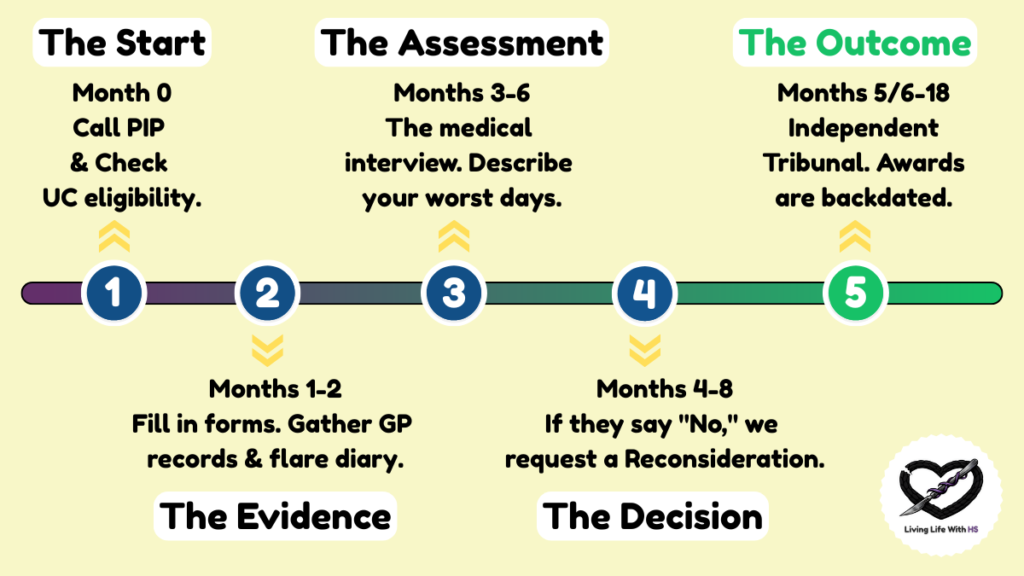
Your 18-Month Plan
Blunt Foreshadowing &
A word of warning before we begin.
The contents of this page are designed to help you receive what you are entitled to, however, there is no escaping the brutal reality that many HS applicants are rejected on their first attempt. It’s crucial to understand that approximately 70% of all cases are overturned at tribunal. The system often leans on the hope that people will give up. 70% – just keep that number in mind.
If this happens to you, do not take this as a personal judgment, nor become too disheartened. It is a bureaucratic hurdle. A rejection letter isn’t the end—it’s the signal to move to the next stage of the plan. We win in the end by being more knowledgeable and persistent. By reading the contents of this page carefully and setting realistic expectations about outcomes and timings, a lot of the stress of applying disappears. Trust us!
Background: The Two Paths to Support
Before we dive into the steps, you need to understand that there are two main ways the UK government provides financial support for people living life with disabilities, such as HS. You may be able to claim one, or both, depending on your situation.
1. Personal Independence Payment (PIP): This is for the extra costs of living with a long-term health condition. It is not means-tested, meaning it doesn’t matter if you have £100,000 in the bank or a full-time job. It’s about your daily living and mobility.
2. LCW or LCWRA via Universal Credit: This is the “Health Element” of Universal Credit. It is for people whose HS makes it impossible to work, or forced them to reduce their hours. This is means-tested based on your household income.
LCW = Limit Capability for Work & LCWRA = Limited Capability for Work-Related Activity.
CRITICAL: Know the difference between LCW and LCWRA
When you apply for the “Health Element” of Universal Credit, the DWP will try to put you into one of two categories. You need to know which is which from the offset and be very clear:
LCW : This pays £0 extra. The DWP agrees you are ill, but they still expect you to attend meetings and “prepare” for work. This is a trap many people fall into.
LCWRA (The Goal): This pays an extra £423.27 per month. You are not required to look for work or attend meetings. This is the award that recognizes the true severity of HS.
The DWP often tries to “settle” for LCW to save money. Do not accept it if your HS makes work impossible. We are fighting for LCWRA.
Whether you are working or not, you should apply for both types of benefit.
1. The Start
The First Steps: To get the ball rolling you can start right now by doing these three things, in this order, to help things flow as smoothly as possible for you:
One – Make a GP Appointment to request your “Fit Note”
The Fit Note Hack: Do this before your first meeting with the DWP at the JobCentre.
To get the extra health money (LCWRA), you need a Fit Note (Med3) from your GP. Do not wait for the DWP to ask for one. Handing a fit note to the DWP starts the clock on your backdated pay.
Getting a fit note from your GP is the starting point, without one, you will not be able to trigger a Work Capabilities Assessment (WCA). Whilst facing the GP can be daunting, this step is critical to everything else and must become your priority. If you have any ongoing issues with your GP, now is the time to put them to one side (for your greater good) and make friends with them again.
Be honest with your GP, explain your situation and let them know you will likely require more than one fit note.
1 – Ask for a 3-Month fit note. GPs often default to 1 month, which means you have to go through the stress of booking another appointment every 4 weeks as there may be a lengthy wait, both getting your WCA and then for the process to takeover from the fit note. For chronic conditions like HS, GPs have the power to write a note for 3 months at a time. Ask for it.
2 – Always make sure to keep a copy of each fit note you receive, take a photo as soon as you receive a new one, better still, ask the GP if they can also email you a digital copy for your records, most will be able to.
3 – Providing continuous fit notes for 29 days is the official trigger that forces the DWP to start your medical assessment and send out the WCA50 form.
4 – Make sure to double check the dates on your fit note to ensure that they continue without missing a day. If a single day has been missed, it can lead to delays. For example. Your GP writes a fit note for one month from the 6th of January, 2026. It runs until the 6th of February, 2026. Therefore, request that your GP write the next one to start on the 6th of February – this ensures no gaps and a smooth overlap. If you need a new fit note, don’t leave it until the last minute. Arrange your appointment at least 1 week before your fit note expires. Note – Your GP can write an advance date for the next fit note to begin.
Two – Call PIP
Make a phone call to the PIP New Claims line: 0800 917 2222. They will ask for basic info such as your name, D.O.B, address, GP details etc. Don’t stress this bit—it’s just to get the paperwork sent out in the post.
Three – Apply for Universal Credit (The Gateway to LCWRA)
If you aren’t claiming UC: Go to gov.uk/apply-universal-credit and start a claim. Even if you are working, you may be eligible for support. This will trigger a meeting to be arranged at a local JobCentre in due course. It is important that you try get a fit note before attending this meeting, to prevent delays. More below.
If you are already claiming UC: Go to your Journal and report a “Change of Circumstances” regarding your health.
Not sure what to write? Try something like this: “I have a chronic inflammatory skin condition called Hidradenitis Suppurativa (HS). It causes recurring, painful abscesses and significant mobility issues. It severely limits my ability to work or look for work. I have a Fit Note from my GP to support this.”
The JobCentre Meeting: Don’t get trapped.
If you are making a fresh claim for Universal Credit, you will be invited to the JobCentre within the first two weeks. This is NOT your medical assessment. You should delay this meeting until you are able to obtain a fit note from your GP first.
This is a “Commitment” meeting. The person you meet (your Work Coach) is a bureaucrat, not a doctor. In our experience, they rarely offer you information about the “Health Element” (LCWRA). You have to be the one to bring it up.
What to do at this meeting:
Hand over your Fit Note. Tell them: “I would like to report a health condition , request a Work Capability Assessment and here is a fit note from my GP.” Attending this meeting and handing over your fit note will trigger the WCA50 form to be sent out in the post, you’re just there to confirm your personal details, your circumstance, and ensure the paperwork gets sent out promptly.
Demand a “Work Allowance.” If they try to set you a target of looking for full-time work, remind them that you are awaiting a Work Capability Assessment (WCA).
Don’t expect them to be the expert. Most Work Coaches have never heard of HS. You are there to make sure they tick the box that says “Health condition reported.”
Note – if for any reason you are delayed in getting a fit note by more than a week or two then do not keep delaying your UC appointment. Attend as normal, state your condition and inform the work coach that you will upload a copy of your fit note to your journal once you have it – by then you should have access to your online account – otherwise referred to as your “Journal”, which is the way you communicate with the DWP between appointments.
2. The Evidence
Providing things have gone to plan, you’ll now have some time on your hands to prepare while the paperwork arrives. You will receive two health questionnaires: the PIP2, for your PIP application and the WCA50 for your LCW/LCWRA application. Let me forewarn you now, the WCA50 is a bit of a hefty document and can seem intimidating. Don’t be intimidated. Later on this page we will walk you through completing both of these forms easily.
They look different, but they want the same thing: proof of how HS affects you. Instead of doing the work twice, gather one “War Chest” of evidence to use for both. Here’s what you need to gather now, while you wait:
GP Summary Record
Ask your GP receptionist for a printout of your “Summary Care Record.” It’s often faster than a full medical history and shows your diagnoses and meds. GPs should reply to all requests within 30 days.
The Surgery List
List every I&D (Incision & Drainage), deroofing, or hospital trip you’ve had, if relevant to you. Try to list the dates; month and year.
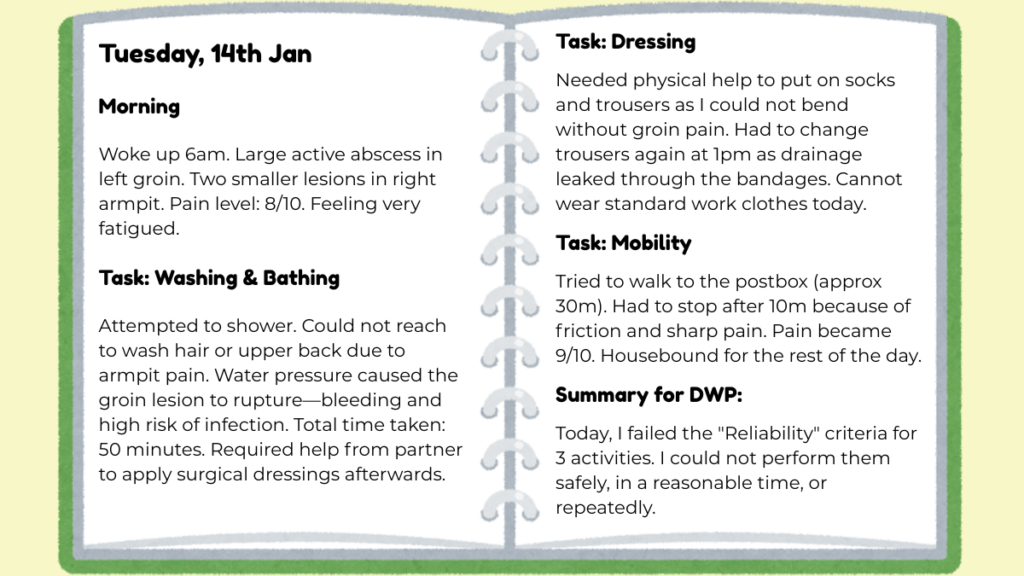
The HS Diary
For one week, write down every time a lesion leaks, every time you have to change a dressing, and every time the pain stops you from sitting or walking. Continue to document your HS and keep a written record. Thinking of PIP, keep any receipts for personal medical equipment you’ve had to buy to manage your HS; plasters, bodywash, extra clothing etc. Anything which you can use as evidence to show that your condition is having an effect on your finances. Paper wins cases.
Tip – In 2026, the easiest way to keep records is by taking photographs on your phone. Create a new folder in your photo library and save them all together in there. Call it something like “medical receipts” to keep track.
Support Statement
Ask someone who sees you at your worst—a partner, friend or parent—to write a short letter describing the help you need with dressings, laundry, moving around or any other day-to-day actions. Make sure that they don’t sugarcoat it and they list as many things as possible—they may worry about upsetting you if they write the naked truth, but that is what is needed here. The more you can demonstrate how HS affects your life the better. Try to be thorough and offer to help if needed.
Realistic Timescales
Trying to understand the order and timelines can be a little confusing at first. This image is designed to help you feel in control about what is happening, when it appears nothing at all is happening.
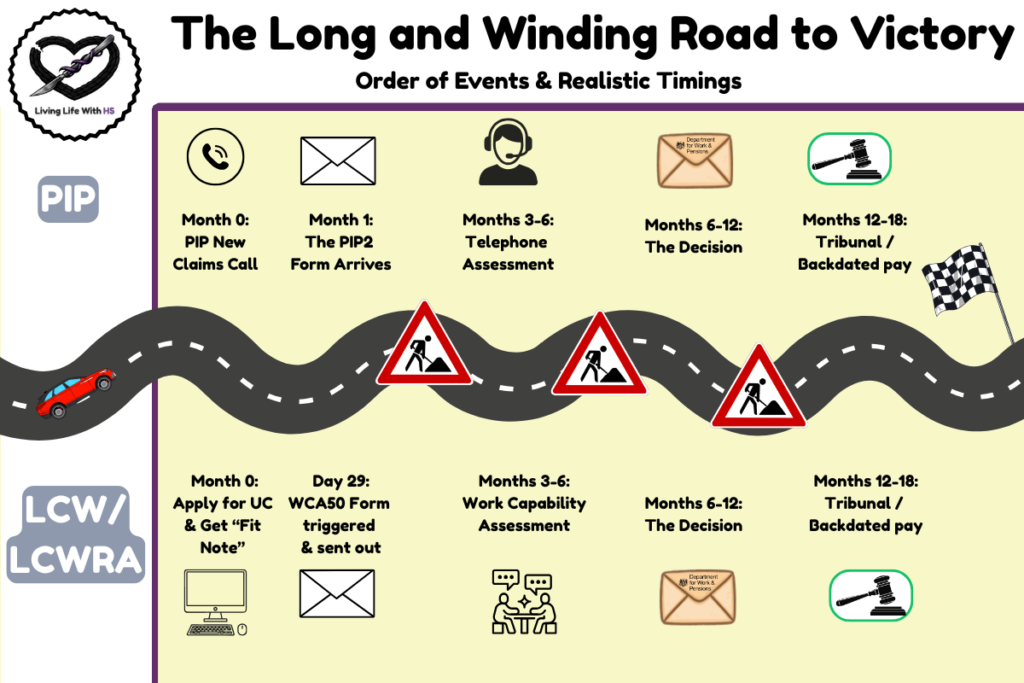
The DWP does not move fast. It is important to know these timings so you don’t feel like your application has fallen into a black hole. Let’s call these “roadworks” along the way. Here are the key timings for you:
JobCentre Appointment (New UC Claim): Usually happens within 1 to 2 weeks of submitting your online application.
Receiving the WCA50 Form: This should happen automatically once you have submitted 29 days of continuous fit notes. If day 30 passes and you haven’t heard anything, leave a message in your Journal asking for your referral as soon as possible.
The Assessment Wait: From the day you send your form back to the day of your actual medical interview, expect to wait 3 to 6 months.
The Result: Once the assessment is over, you will usually see a letter in your UC Journal or through the post within 2 to 4 weeks.
Pro-Tip: If you are awarded LCWRA, the extra money is backdated to the date you provided your first Fit Note, but there is a mandatory 3-month waiting period where you won’t see the extra cash. This is why starting on Day One is vital.
3. The Assessment:
Winning the “Functional” Test
Right then. You’ve done the hard graft. You’ve sent off your PIP2 form and your WCA50 health questionnaire. You’ve had your first JobCentre meeting and your fit notes are being uploaded. Now, you’re in the waiting period. Eventually, you will be invited to your medical assessments. It is vital you don’t get these muddled up, as they are testing two different things:
- The PIP Assessment: They are looking at your home life. Can you wash, dress, and move around your own house safely? This is usually a telephone call.
- The UC Assessment (WCA): They are looking at your work life. Can you sit, stand, reach, and stay focused in a workplace? This can be in-person, video, or phone.
While the questions are different, the strategy for winning is exactly the same for both. You have to stop being “brave” and start being literal.
The Golden Rule: Describe your worst day.
If you tell an assessor you are “alright today,” they will write down that you are cured. You must describe your life when you are in a flare—when you are bleeding, in pain, and cannot move. That is your reality, and that is what they need to hear.
The “Reliability” Rule: Your Legal Shield.
By law, the DWP can only say you “can” do a task if you can do it RELIABLY. If you can’t do it safely, to an acceptable standard, repeatedly, and in a reasonable time, you cannot do it.
Remember STAR:
S – Safely: Does it cause a lesion to burst? Does it risk infection?
T – Time: Does it take you more than twice as long as a “healthy” person? (e.g., 20 mins to get dressed).
A – Acceptable Standard: Can you actually get clean, or are you just “dabbing” at yourself because the water hurts too much?
R – Repeatedly: If you manage to wash your hair at 8 am, are you in too much pain to do anything else for the rest of the day? If you can’t do it “as often as required,” you can’t do it.
The Scoring Criteria: 12 Activities
To be awarded PIP, you have to score points across 12 Activities split into two categories: Daily Living & Mobility. You are scored separately for Daily Living and Mobility. You can be awarded support for one, or both.
The Scale: For each activity, you are scored 0, 2, 4, 8, or 12 points. They don’t add them up within one activity; they just take the highest score that applies to you for more than 50% of the time.
Daily Living (10 Activities)
Standard Rate (8–11 points): £73.90 per week.
Enhanced Rate (12+ points): £110.40 per week.
Mobility (2 Activities)
Standard Rate (8–11 points): £29.20 per week.
Enhanced Rate (12+ points): £77.05 per week.
Note: To get the “Full Support” package, you are aiming for 12 points in each category.
How the points are calculated (The “Highest Fit” Rule):
Within each activity, the DWP looks at a list of scenarios. They don’t add them up; they just pick the highest one that applies to you for more than half the time.
Example: Preparing Food
Scenario A: You need a special tool (like a perching stool) = 2 points.
Scenario B: You need someone to “prompt” or remind you = 2 points.
Scenario C: You need someone to physically help you prepare the meal = 4 points.
If all three apply to you because of your HS, you do not get 8 points. You get 4 points (the highest one). You then move to the next activity (like Washing) and start scoring there. All your “highest fits” are then added together for your final total.
The 12 Activities They Test
Daily Living: 1. Preparing food | 2. Taking nutrition | 3. Managing therapy | 4. Washing/Bathing | 5. Toilet needs | 6. Dressing/Undressing | 7. Communicating | 8. Reading | 9. Socialising | 10. Making money decisions.
Mobility: 1. Planning a journey | 2. Moving around.
Accurate Responses vs. Common Mistakes
Example 1 – Sitting & Standing (Daily Living)
- ❌ Common Mistake (0 Points): “I can sit at a desk, but I have to move around a lot.”
- Why it fails: You’ve admitted you can do it. The assessor will just write “Can sit at desk.”
- ✅ Accurate Description (Points Scored): “No. I cannot sit in a standard office chair for more than 30 minutes. Chronic perianal and buttock lesions mean that sitting causes extreme pain and triggers drainage. I cannot remain at a workstation reliably or repeatedly without risking a medical flare-up.”
Example 2: Dressing and Undressing (Daily Living)
- ❌ Common Mistake (0 Points):“I can dress myself, but it takes me a long time and I have to be careful.”
- Why it fails: You’ve admitted you can do it. The assessor will just write “Can dress independently.”
- ✅ Accurate Description (Points Scored): “No. I cannot dress myself reliably or in a reasonable time. Due to groin and thigh lesions, I cannot bend to put on socks or trousers without physical assistance. Because my wounds leak pus and blood through my dressings, I frequently have to change my clothes 3 or 4 times a day. This is slow, painful, and I cannot do it to an acceptable standard by myself.”
Example 3: Moving Around (Mobility)
- ❌ Common Mistake (0 Points):“I can walk to the end of the street, but I have to stop for a breather because it hurts.”
- Why it fails: If you reached the end of the street, they’ll say you can walk over 200 metres.
- ✅ Accurate Description (Points Scored): “No. I cannot walk more than 20 metres safely or repeatedly. Painful lesions in my groin and inner thighs cause intense friction and bleeding with every step. If I walk to the end of my drive, the pain is so severe (9/10) that I am unable to walk again for the rest of the day. It is not a safe or repeatable action.”
The Financial Reality
Like the PIP assessment, the DWP uses the Work Capability Assessment as a scoring method in order to put you into one of three categories. Only, it’s slightly different this time and works as follows:
Fit for Work: 0 points. You get your standard UC and must look for full-time work.
LCW (Limited Capability for Work): 15 points total across all categories. This pays £0 extra. You must still attend meetings and “prepare” for work.
LCWRA (The Goal): You meet one of the high-scoring criteria below. This pays £423.27 extra per month and ends all work-related requirements. *Correct as of February, 2026.
The Scoring Criteria: 17 Activities
To be awarded the benefits, you generally need to score 15 points in one single physical activity or meet the “Substantial Risk” rule. There is no set rule on how many questions you may be asked, but an estimate would be between 12 and 20. The assessor will ask as many questions as they deem necessary to be able to fully complete the paperwork in front of them.
Physical Activities (1–10 )
- Mobilising (Walking or using a wheelchair): Can you move 50m, 100m, or 200m on level ground reliably? (15 points for <50m).
- Sitting and Standing: Can you remain at a workstation for 30 minutes or 60 minutes without needing to move away? (15 points if you can’t do 30 mins).
- Reaching: Can you raise either arm as if to put on a hat or reach into a jacket pocket? (15 points if you can’t reach the top of your head).
- Picking up and Moving: Can you lift a 0.5-litre carton of liquid or a large book?
- Manual Dexterity: Can you use a keyboard, a mouse, or turn a tap?
- Making yourself understood: Can you speak clearly to a stranger?
- Understanding others: Can you hear or understand what people are saying?
- Navigation and Maintaining Safety: Can you get around safely without help?
- Continence: Do you have control over your bowels or bladder? (15 points if you have weekly “accidents” or need to manage dressings/leakage constantly).
- Consciousness: Do you have “blackouts” or seizures during waking hours?
Mental & Cognitive Activities (11–17)
- Learning Tasks: Can you learn a simple or moderately complex task?
- Awareness of Hazards: Can you stay safe around fire, traffic, or electricity?
- Initiating Action: Can you get up and start your day without being told?
- Coping with Change: Does a change in routine cause you significant distress?
- Getting About: Can you go to a place you know, or a place you don’t know, by yourself?
- Social Engagement: Can you interact with people without feeling overwhelmed or anxious?
- Appropriateness of Behaviour: Do you have “uncontrollable” outbursts in public?
Accurate Responses vs. Common Mistakes
Example 1: Sitting and Standing (Activity 2)
- ❌ Common Mistake (0 Points):“I can sit at a desk, I just have to stand up and stretch every 20 minutes.”
- Why it fails: The DWP will say you are “fit for work” because you can manage the task with breaks.
- ✅ Accurate Description (15 Points): “No. I cannot remain seated in a standard chair for more than 30 minutes. Chronic perianal and buttock lesions mean that sitting causes extreme pressure and excruciating pain. I cannot remain at a workstation to an acceptable standard because I have to frequently leave to manage weeping wounds in a private, sterile environment.”
Example 2: Reaching (Activity 3)
- ❌ Common Mistake (0 Points):“It hurts to reach up, but I can get things off a shelf if I really need to.”
- Why it fails: If you do it once, they count it as “Can do.”
- ✅ Accurate Description (15 Points): “No. I cannot reach above my head safely or repeatedly. Due to active abscesses in both armpits, raising my arms causes the skin to tear and lesions to rupture. This causes significant bleeding and a high risk of infection. I cannot perform this action to an acceptable standard.”
Example 3: Mobilising (Activity 1)
- ❌ Common Mistake (0 Points):“I can walk to the local shop, but I have to go very slowly.”
- Why it fails: If you reached the shop, they will say you can walk 200+ metres.
- ✅ Accurate Description (15 Points): “No. I cannot walk more than 50 metres reliably or repeatedly. Painful lesions in my groin cause intense friction and bleeding. If I walk 50 metres, the pain is so severe (9/10) that I am unable to walk again for the rest of the day. It is not a safe or repeatable action.”
The “Trap” Warning
Warning: The assessor may seem to only ask you a few questions. If they see you walk into the room or sit comfortably for 5 minutes, they might “skip” questions and assume you have no issues.
Your Job: If they try to move on and you haven’t told them about the pain or leakage in that area, stop them. Say: “Wait, we haven’t discussed how my HS affects my ability to [Activity] reliably.”. Be proactive during the call/appointment and keep a checklist by your side during the call to ensure all activity areas are covered.
The Substantial Risk Rule (Regulation 35)
This is the most important “Smart Alec” tool for HS. Even if you don’t score 15 points, you must be awarded LCWRA if:
“Being found fit for work (or fit for work-related activity) would pose a substantial risk to your mental or physical health.”
How to use this: Tell the assessor: “If I am forced into a workplace, the friction, lack of hygiene facilities for dressing changes, and physical stress will cause my HS to flare into a medical emergency. This is a substantial risk to both my mental and physical health.”
4. The Decision & Next Stages
The Initial Wait (Post-Assessment)
After you’ve finished your assessment, the silence can be deafening. You’ve bared your soul (and possibly your skin), and now you’re waiting on a decision.
Universal Credit: You will usually see a letter uploaded to your Journal within 2 weeks.
PIP: The brown envelope usually hits the doormat within 2 to 4 weeks.
If the decision is “No” and says you have been awarded “0 points” or are “Fit for Work,” do not panic.
This is the DWP’s opening move. They are banking on you being too exhausted to challenge them. You have exactly one month from the date on that letter to ask for a Mandatory Reconsideration (MR). From the date on the letter, not the date it arrives. To be clear, the process is exactly the same for both PIP and LCWRA Applications, it’s just that the timings and assessment criteria change.
What is the MR process?
The MR is a “paper review.” You don’t usually have another interview. Instead, a different decision-maker looks at your original file plus any new evidence you’ve sent in.
How long is the MR wait?
This is the hardest part of the slog.
For PIP: Expect to wait anywhere from 4 to 10 weeks. The DWP’s official target is 42 days, but they often blow past it.
For Universal Credit (LCW/LCWRA): This is usually faster, often appearing in your Journal within 2 to 4 weeks.
The Blunt Truth:
In the vast majority of cases, the DWP will “rubber stamp” their original decision and say “No” again at the MR stage. Do not let this break you. They are testing your resolve. Only about 15-20% of decisions are changed here. The MR is often just a necessary hurdle you have to jump before you can get to the Independent Tribunal, where the real wins happen.
The Appeal: How to Lodge a Challenge
If your Mandatory Reconsideration (MR) is rejected, you have one month from the date on the letter to appeal to the Independent Tribunal. This is done using Form SSCS1. You can do this online at gov.uk/appeal-benefit-decision. This form should be used to appeal any DWP decision, so in this case you would need to fill in this form for both PIP and LCWRA appeals. Two forms. Two appeals (if it comes to that)
The “Smart Alec” Wording. Feel free to copy & paste these:
When the form asks why you are appealing, don’t just say “I am in pain.” Use the law to back them into a corner.
For PIP (Personal Independence Payment):
“I disagree with the decision because the DWP has failed to correctly apply Regulation 4(2A) of the PIP Regulations 2013. Under this law, I only ‘count’ as being able to do a task if I can do it RELIABLY. Due to my HS, I cannot [Wash/Dress/Drive/Move] safely, to an acceptable standard, repeatedly, or in a reasonable time. The DWP assessor has ignored the fluctuating and severe nature of my condition. I would like to be reassessed at an inedependent tribubal. Please consider this my formal request
For Universal Credit (LCWRA):
“I am appealing the Work Capability Assessment decision. The DWP has failed to account for the ‘substantial risk’ to my health (under Schedule 8 or 9 of the UC Regulations) if I am found fit for work. My Hidradenitis Suppurativa is a chronic, systemic condition that requires intensive wound management which is incompatible with a standard workplace environment.”
5. The Outcome: Results and Backdated Pay
The “Lapsed Appeal” (The Phone Call Victory):
Before you even set foot in a courtroom, something interesting often happens. Once you lodge your tribunal appeal, the DWP’s legal team reviews your “War Chest” of evidence. If they realise they are likely to lose, they may call you. This is called a “Lapsed Appeal.” A DWP officer will call to discuss your case and may offer to reverse the decision on the spot.
Remember all those precise words we used earlier, STAR? Safely, Time, Acceptable Standard and Repeatedly/Reliably. This is where they pay dividends and likely win the case for you at this stage.
Our Advice: Stay calm and listen. If they offer to reverse the decision, ask them exactly which award they are offering. If they offer you LCW, remember that it pays £0 extra. If you know you are entitled to LCWRA, tell them: “I appreciate the offer, but I am appealing for LCWRA because I cannot reliably carry out work-related activity.”
They may go away, “check with a manager,” and call you back with the full award. Don’t let them buy you off with a title that doesn’t come with the support you need.
The Tribunal.
If it goes all the way to the Independent Tribunal, remember this number: 70% of people win here. Unlike the DWP, the Tribunal is independent. You will talk to a Judge and a Doctor who are legally required to apply the Reliability Rule fairly. They will see the reality of your HS, not just the DWP’s checkboxes.
The Wait: 6 to 12 Months
Once you send off your SSCS1 form, you are back in the waiting game. Depending on where you live in the UK, it can take anywhere from 6 to 12 months to get a hearing date. Don’t let this silence discourage you—your backdated pay is growing every single day you wait. At the same time, be mindful not to “bank on it” – victory is never guaranteed and you have to fight correctly until the very end. Continue to keep a record of how HS affects your daily life and your ability to work. You can present this as more recent evidence to coroborate your claims during your tribunal.
Tip – Maintaining records is another reason why many people may switch off and lose hope, especially with such a long wait. Don’t do this, stay vigilant with the home stretch in sight. Take photos of everything and organise them in folders on your phone. Once a month spend 15 minutes sorting though and organising those images, then email them to yourself. When it comes to the month before the tribunal, it will be a simple task for you to bring together all of your new evidence by searching your emails. You’re welcome 🙂
Who will be there? (The Panel)
Unlike the DWP, you are now dealing with the Ministry of Justice. You will sit with three independent people:
The Judge: A legal expert who ensures the law (like Regulation 4) is followed.
The Doctor: A medical professional who understands how chronic illness works.
The Disability Expert: Someone with a background in social care who understands the practical struggle of daily life.
Do I need a lawyer?
Honestly? No. Most people attend their own tribunals. The panel is there to help you explain your case, not to cross-examine you like a criminal. However, I highly recommend taking a “Wingman”—a partner, parent, or friend. They can sit with you, take notes, and give you a nudge if you forget to mention something important.
What will they ask?
They aren’t there to re-diagnose you. They will ask functional questions based on all the evidence you have submitted throughout the process.
“Tell us how you got here today. Did you take the bus or a taxi? How was the walk from the car park?”
“You mentioned armpit flares—how exactly does that stop you from washing your hair?”
“On a bad day, how many times do you have to change your dressings?”
How to prepare.
Bring your War Chest: Have your surgery list and flare diary on the table in front of you.
Be Brutally Honest: If you are in pain sitting in their chair, tell them. If you had to use an adult nappy to get to the building, say so.
The “Worst Day” Rule: Always answer based on your worst days. If you say “I manage,” you lose. If you remember to use STAR to state your case and state things like: “I cannot do it Reliably because of X, Y, and Z,” you are much more likely to win in the end.
The Payday:
When you win, your award is backdated to the very first day you started the claim (Month 0). For many, this results in a life-changing lump sum of thousands of pounds, followed by the monthly support you deserve.
The Warrior Mindset: Never take “No” for an answer.
If the answer is still “No,” it is not the end. You can start a fresh claim the very next day. There is no limit to how many times you can apply. You gather more evidence, you learn from the process, and you go again. You win in the end by being more persistent than the machine.
The Bottom Line: Let’s talk numbers
The effort of applying is massive, especially when you’re in pain. But the financial support is a legal entitlement that can change your life. Here is what that support looks like in practice based on the 2025/26 benefit rates.
PIP Rates (Weekly)
PIP is paid every 4 weeks. It is made up of two parts. You might get one, or both.
- Daily Living Component (per week):
- Standard Rate: £73.90
- Enhanced Rate: £110.40
- Mobility Component:
- Standard Rate: £29.20
- Enhanced Rate: £77.05
Note: If you are awarded both “Enhanced” rates, you receive roughly £751 every four weeks. Not small change.
Universal Credit Rates (Monthly)
Universal Credit is paid monthly. The “Standard Allowance” depends on your age and relationship status.
- Standard Allowance (Single, 25+): ≈ £400.14
- Standard Allowance (Couple, both 25+): ≈ £630.60
- The LCWRA Element (The Health Top-up): ≈ £423.27
Important: The LCWRA element is the “extra” money you get specifically because HS limits your ability to work.
Note on Pay Dates:
Unlike PIP, which is paid every 4 weeks (meaning the date changes), Universal Credit is paid on a fixed date every month. Your pay date is set 7 days after your first one-month “assessment period” ends. If your pay date falls on a weekend or bank holiday, you’ll be paid on the working day before.
The April 2026 “Health Element” Reform
The government is planning to change how UC works from April 2026.
- Protected Rate: If you already have LCWRA before April 2026, you should keep your higher rate (around £423).
- New Lower Rate: Most new claimants found to have limited capability for work after April 2026 may receive a lower “Health Element” of around £217 per month.
Monthly Income in Practice (The Scenarios)
Worked Examples: What hits your bank account?
These scenarios assume you have no other earnings or savings above £16,000, no deductions, and that your rent is covered by the Housing Element. Note – If you hold savings between £6000 and £16,000 this will affect your Universal Credit payment amount, on a sliding scale. However, it will not affect your PIP entitlement in any way. Savings include investments in the stock market and crypto.
Example A – Single adult, no children, renting (LCWRA + Standard PIP)
- Status: Age 30, living alone.
- Monthly Breakdown:
- UC Standard Allowance: ~£400
- UC LCWRA Element: ~£423
- UC Housing Element: £500
- PIP Standard Daily Living: ≈£321
- Total Monthly Income ≈ £1,644
Example B – Single adult, renting (Post-2026 Reform Pattern)
- Status: Age 27, lone tenant, decision after April 2026.
- Monthly Breakdown:
- UC Standard Allowance: ~£425
- New Health Element: ~£217
- Housing Element: £500
- PIP Enhanced Daily Living: ≈£478
- PIP Enhanced Mobility: ≈£333
- Total Monthly Income ≈ £1,953
Example C – Couple, no children, renting (One partner with HS)
- Status: Both over 25, one partner with severe HS.
- Monthly Breakdown:
- UC Standard Allowance (Couple): ~£631
- LCWRA Element: ~£423
- Housing Element: £700
- PIP Enhanced Daily Living: ≈£478
- Total Monthly Income ≈ £2,232
Example D – Single adult homeowner (LCW only + Standard PIP)
- Status: Homeowner, no housing element, found “Fit for Work” but with limited capability (LCW).
- Monthly Breakdown:
- UC Standard Allowance: ~£400
- LCW Element: £0 extra
- PIP Standard Daily Living: ≈£321
- Total Monthly Income ≈ £721
Note: This example shows exactly why you must fight for the full LCWRA award.
Example E – Single parent with one child, renting (LCWRA + Standard PIP)
- Status: One six-year-old child.
- Monthly Breakdown:
- UC Standard Allowance: ~£400
- Child Element (First child): ~£330
- LCWRA: ~£423
- Housing: £650
- Total Monthly Income ≈ £2,124 (including PIP)
Disclaimer
The Living Life With HS website and the views displayed on it are not those of a medical professional. The information and stories on this website are based on personal experience(s) and are for informational and community support purposes only. This content is not a substitute for professional medical advice, diagnosis, or treatment. Always seek the advice of your GP or other qualified health provider with any questions you may have regarding a medical condition.