
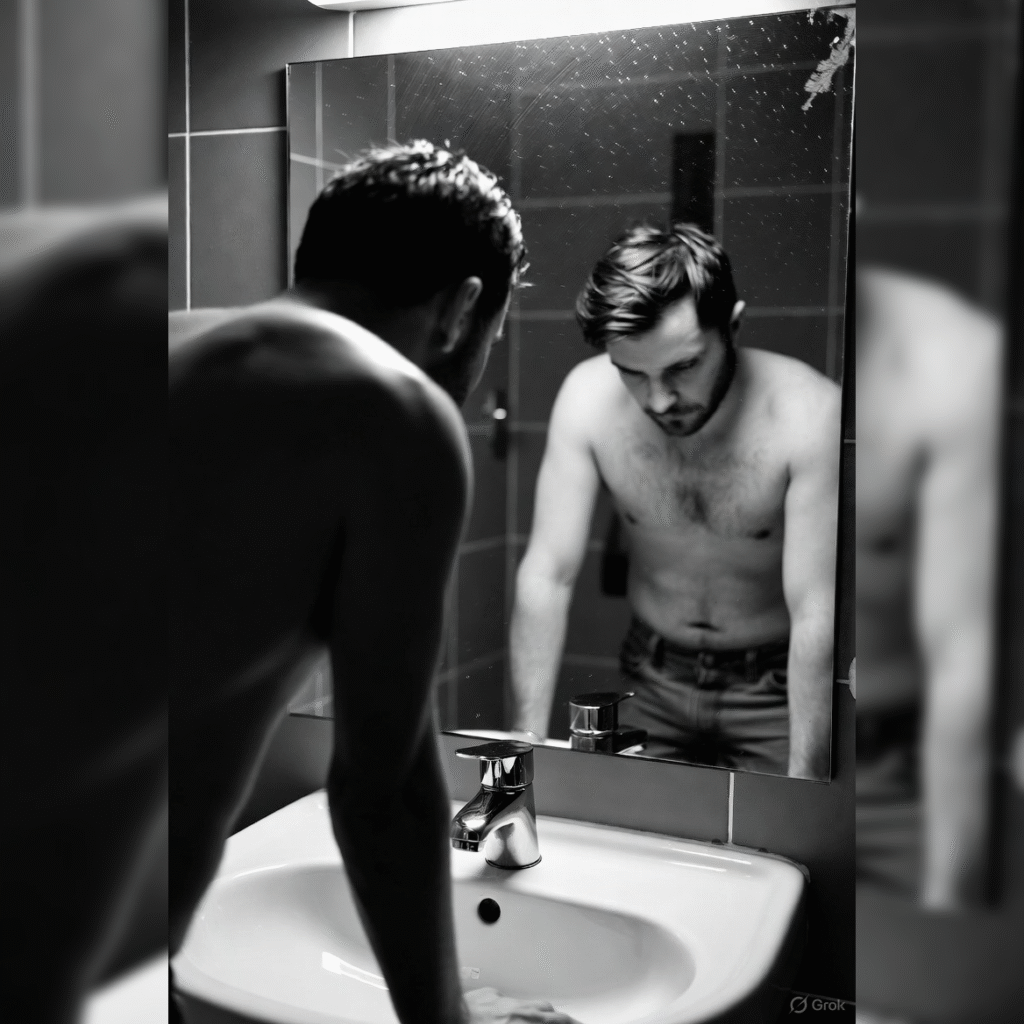
From the time we’re lads, we’re given the rulebook. Men are strong. Men provide. Men are resilient. Men don’t complain; they just get on with it. We’re meant to be the rock, the foundation, the one who can handle anything. But what happens when the thing that’s trying to break you is your own body? What happens when the battle isn’t on a football pitch or in a boardroom, but in your own skin, in the most private, vulnerable parts of yourself? This is the invisible battle of HS and masculinity.
It’s a conversation we rarely have. It feels self-indulgent to talk about how this disease makes us feel. But the quiet erosion of your identity as a man—that’s a deeper kind of wound. This isn’t just a topic for the blokes, either. If you’re a woman living with or loving a man who is fighting this war, this is for you, too. This is a look behind the curtain of stoicism we’re all taught to wear.
(For a broader perspective on this, my post “I’m Not a F***ing Failure” is a vital part of this same conversation.)
The Invisible Assault: When Your Body Breaks the Rules
The first thing HS attacks is your sense of control. The male role is one of action, of fixing things. You get a problem, you find a solution. But with HS, there is no easy fix. You can’t just “man up” and make it go away. It forces you into a passive role, a victim of your own immune system, and that feels fundamentally wrong. This is the shame of being unreliable. Of having to cancel plans. Of not being able to pick up your child without a jolt of agony. And it’s the shame of having to ask for help—whether it’s asking your partner to change a dressing in an impossible-to-reach spot or asking your dad for a financial bailout because you’ve missed too much work. Every request feels like a quiet admission of defeat, a chip hacked away from that foundation of independence you’re supposed to have.
The Shame in the Mirror: Navigating a Private War
Then there is the physical battle. Our culture is saturated with images of the “ideal” male body—strong, unblemished, perfect. HS makes a mockery of that ideal. It leaves scars. It leaks. It can smell. It often attacks the very parts of your body that are intrinsically linked to masculinity and intimacy. How do you feel like a desirable partner when you’re worried about a wound bursting? It builds a wall around you, brick by humiliating brick, isolating you from the very connection you crave. It’s a profound loneliness that happens behind a closed bathroom door, staring into a mirror and not recognising the battered warrior looking back at you.
Forging a New Armour: Redefining Strength on Your Own Terms
So how do we fight back? It’s not about ignoring the pain or pretending you’re some invincible hero. The bravest thing I ever did was admit how broken I felt. Real strength, I’ve learned, isn’t about being an unbreachable fortress. It’s about having the courage to be vulnerable. To say to your partner, “I’m not okay today.” To tell a mate, “I can’t make it, I’m in a bad way.” It’s about looking in that mirror, past the scars, and acknowledging the man who is still standing, despite it all. Our identity is not defined by our physical shell; it’s defined by our actions. By showing up for our kids even when we’re in agony. By finding a way to earn a living. By having the guts to be honest about our struggle. That’s a different kind of strength. It’s quieter, it’s uglier, but it’s a hell of a lot more real.
This is a deep one, I know. For the blokes reading this, does this resonate? For the partners, does this help you understand? Let’s talk about it in the comments. We’re all in this together.
For any man struggling with these feelings, please know there are people you can talk to. Organisations like The CALMzone (Campaign Against Living Miserably) are there to listen.
Pingback: The HS Gender Gap: Why Men With HS Suffer Differently